
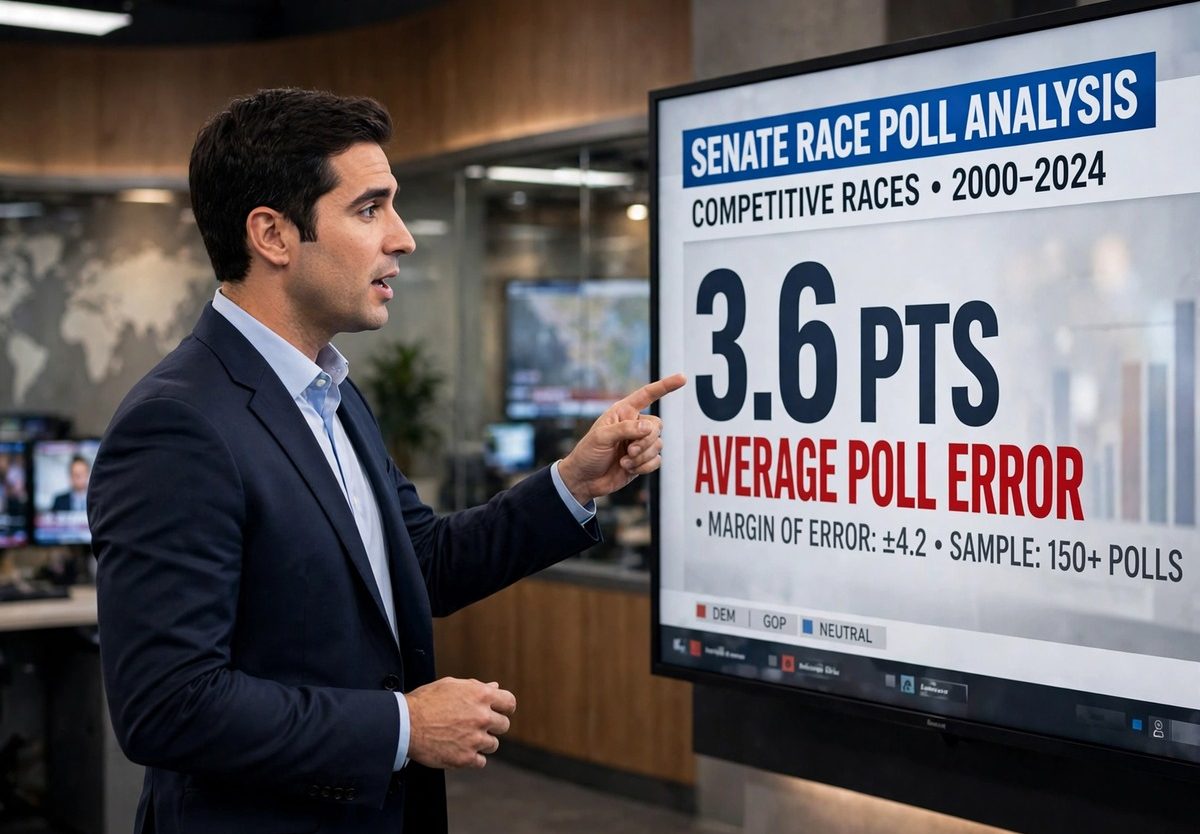
CNN analyst Harry Enten says a historical polling miss toward Republicans could produce a 52-48 Senate and preserve GOP control of the House.
Republicans could finish the 2026 Senate map with 52 seats and keep control of the House if close-race polling misses toward the GOP, CNN political analyst Harry Enten said Friday.
Enten’s projection came with a clear condition: Republicans would need to outperform the current polling averages by roughly the historical error seen in close Senate contests. Under that scenario, the GOP would win races in Maine, Michigan, Texas, Kansas, Iowa, and Alaska, producing a 52-48 Senate split.
That possibility matters because Democrats need to win at least three key races to take Senate control, while current averages show them with narrow leads or ties in Kansas, Iowa, Maine, Texas, Michigan, and Ohio. The margins are small enough that the polling does not settle the outcome.
The Polls Leave Room for a Big Shift
Speaking with Sara Sidner, Enten reviewed final Senate polling averages from close races. His comparison used polls conducted during the last 21 days of a campaign and looked at contests decided by five points or less since 1998.
His finding was that those polling aggregates missed the final result by an average of 3.7 percentage points. Because many of the current battlegrounds fall inside that range, Enten said the Senate is still too close to call if the present averages hold through Election Day.
The key issue is direction. A polling error of that size would not automatically help either party, but Enten modeled what the map would look like if Republicans again performed better than their polls. He used a 3.75-point GOP overperformance as the example.
Enten Calls It a Warning for Democrats
Enten called that possibility a “big siren warning sign for Democrats,” noting that Democrats have previously held polling leads that disappeared once votes were cast and counted. His point was not that the Republican outcome is guaranteed. It was that the current margins leave enough room for a familiar polling miss to change control of the chamber.
Why It Matters
This is more than a disagreement over a single forecast. It shows how a narrow polling lead can look stronger than it really is when several contests sit inside the normal uncertainty of election surveys. For voters and campaigns, the practical stake is control of the Senate and the ability of either party to turn small state-level advantages into a national governing advantage.
The people most directly affected are voters in the states Enten identified, along with candidates and party organizations trying to decide where to spend time and resources. Democrats cannot treat a small lead as a locked-in win, while Republicans have a reason to view the map as competitive. The forecast remains conditional, however, because it depends on whether the historical pattern of polling misses appears again.
The open question is what happens between the polling averages and the counted vote. Will the final results resemble the surveys, or will turnout and voter preferences produce another gap? The source does not resolve that question. It makes the uncertainty the central fact: a modest shift across several close races could determine both Senate control and the House outcome.
The Map Still Comes Down to Turnout
The projection shared in the discussion gives Republicans wins in the six states Enten named and says the party would easily maintain House control. A post by Eric Daugherty, included below, made the same broader argument about turnout and pointed to Mike Rogers coming within roughly 19,000 votes of winning Michigan in 2024.
That message turned the forecast into a call for Republicans to vote across the battleground states, including Texas, Ohio, Alaska, Maine, and Michigan. The underlying point is straightforward: if the historical polling error breaks toward the GOP, Enten’s model shows Republicans at 52 seats to Democrats’ 48, with the House staying in Republican hands.
Source: The Gateway Pundit


Leave a Comment