
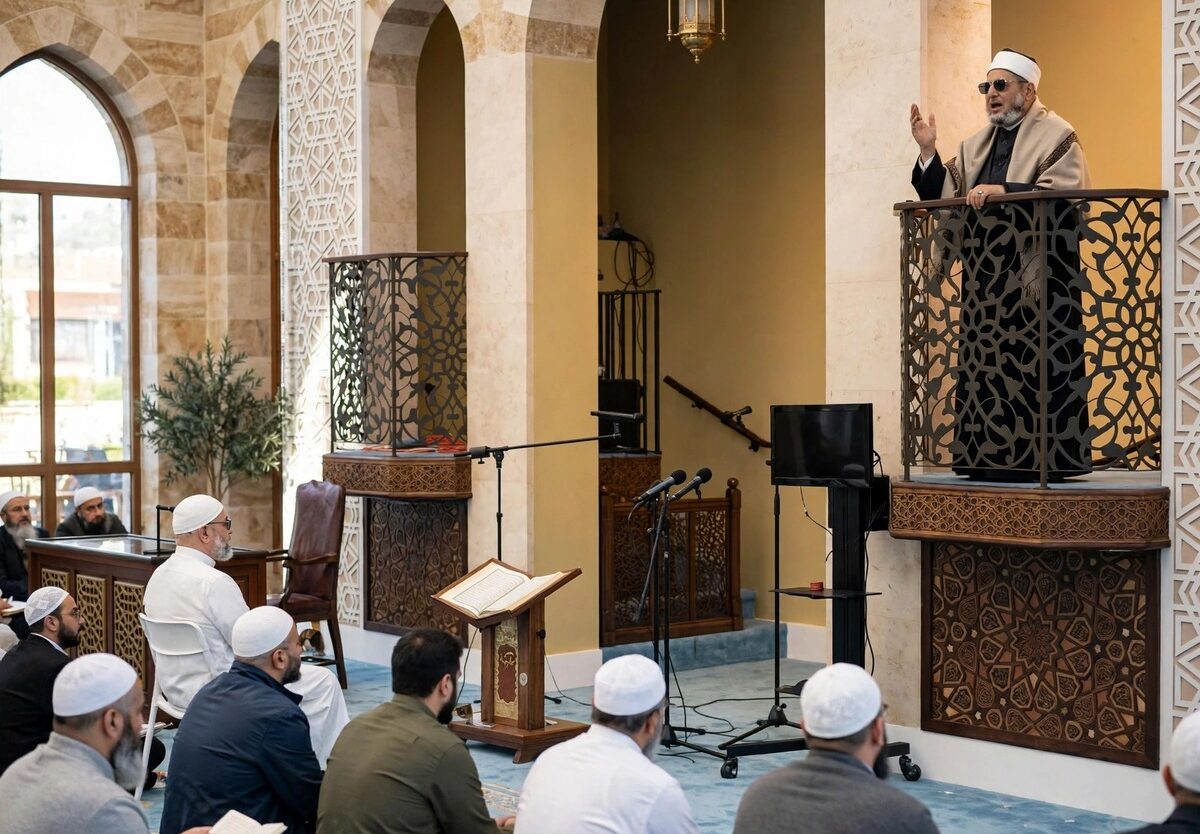
Dave Rubin is urging an investigation after a reported North Austin prayer-service video includes a preacher calling for violence against “infidels” and draws scrutiny over city grants.
Dave Rubin is demanding action over a video from an Austin mosque that appears to call for the deaths of “infidels.” The clip, shared by Eyal Yakoby, is presented as footage from a Friday service at the North Austin Muslim Community. It has moved a local religious gathering into a wider fight over violent rhetoric, public money, and whether authorities will investigate.
The preacher is heard invoking Allah, asking for victory for mujahideen, and calling for punishment against alleged oppressors. The most alarming line is: “Count them by number, kill them one after another, and do not leave a single one of them.” The report does not identify the speaker by name, so the immediate dispute centers on what the recording shows and how officials should respond.
The writer places the footage against the memory of 9/11 and argues that Americans have become less attentive to the ideology behind that attack. That is the article’s framing. The evidence it presents for the current controversy is the prayer recording, its rapid circulation, and the reactions that followed.
Rubin wrote that the remarks should not be dismissed as protected speech and called for an arrest and investigation. Other posts described the language as appalling, warned about the possibility of future terrorism, or pressed Texas officials to act. The clash is no longer only about a sermon. It now includes questions about criminal law, public accountability, and the limits of political silence.
The report says the City of Austin awarded the mosque $3,000 through a food justice grant in 2023, followed by another $30,000 through its Equity Office in 2024. That funding detail has become a second flashpoint. Critics are asking whether public money should go to an institution now associated with violent language, although the funding claim by itself does not show that either grant paid for or endorsed the sermon.
Other posts widened the dispute to Texas politics and the risk of a larger terror attack. One described the footage as incompatible with Western civilization, while another raised questions about a terrorism designation involving CAIR. The source also includes a warning that the probability of a large-scale attack may not be low. Those reactions show how quickly one video can become a proxy fight over security, law enforcement, political leadership, and trust in local institutions.
Why It Matters
The importance of this episode is the gap between a disturbing recording and the public response it can trigger. If the clip is accurately represented, it raises questions about what religious institutions allow from their platforms, how officials evaluate grants, and where authorities draw the line between protected expression and language that may be treated as incitement. Those questions affect worshippers, nearby residents, law enforcement, and taxpayers, not only the people arguing over the video online. They also require care, because a speaker’s words should not automatically be treated as the views of every person who attends a mosque.
The report places the Austin footage inside a larger argument about jihadist rhetoric, memories of mass-casualty terrorism, and whether American institutions respond consistently when extremist language appears. That framing should not be used to blame an entire faith or community for one speaker’s alleged remarks. The unresolved issues are narrower and more concrete: whether the recording is being interpreted accurately, what the speaker intended, and whether local or state officials will investigate the allegations and explain their response. The funding question adds another layer, since taxpayers may want accountability without assuming that a grant financed or approved the message.
The report ends by connecting the debate to a separate Austin shooting on March 1. It says Ndiaga Diagne, a naturalized U.S. citizen wearing a “Property of Allah” sweatshirt, opened fire at Buford’s Backyard Beer Garden, killing three and wounding at least 12 others. Officers stopped the shooting by killing Diagne, and the article says progressive groups then demanded that the officers be charged with his murder. By placing that case beside the prayer footage, the report argues that violent language should be treated as a serious warning rather than ignored as another online controversy.
Source: Townhall

Leave a Comment