
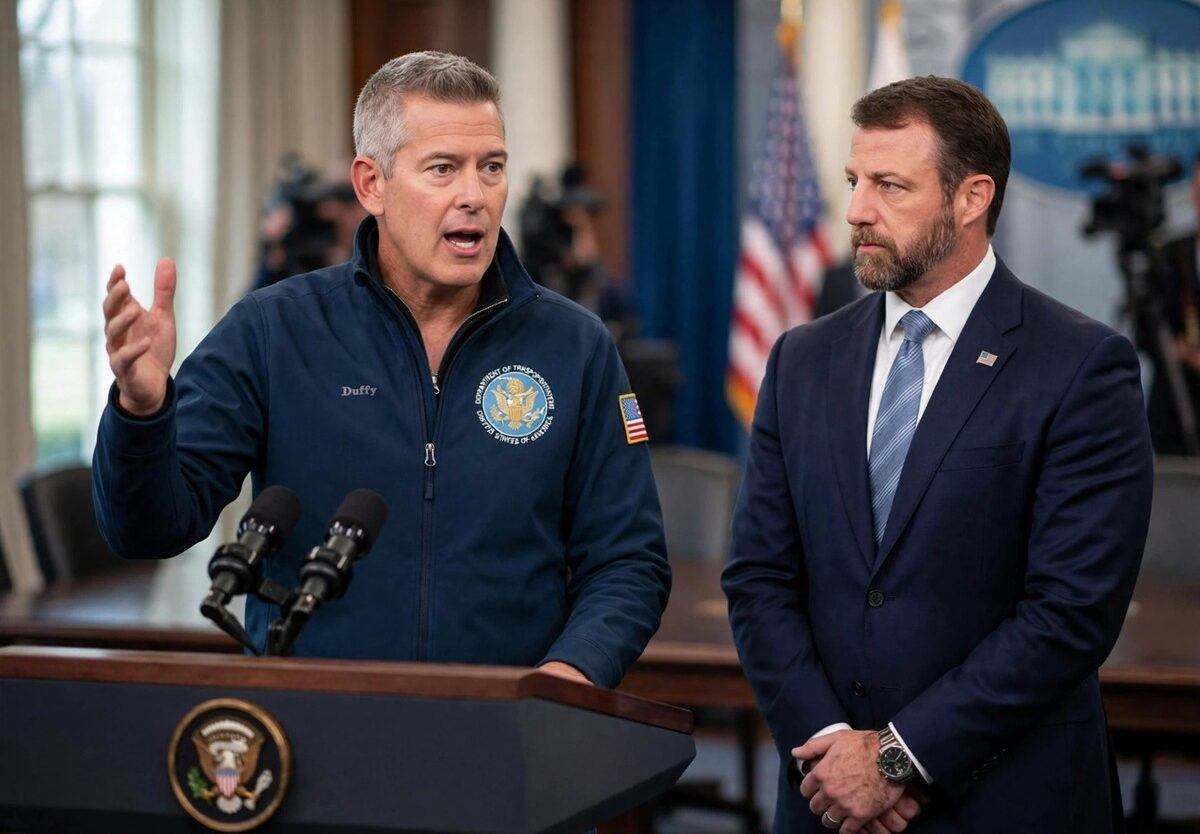
Sean Duffy says a router overwhelmed the aging FAA air traffic control network, forcing a nationwide departure halt while airlines worked through thousands of disrupted flights.
Transportation Secretary Sean Duffy says a failure inside the FAA’s air traffic control network forced a nationwide halt to departures, leaving travelers stranded while airlines began a difficult recovery.
By Saturday morning, officials said the system had stabilized, aircraft were leaving gates and departing again, and the airspace was safe. The shutdown was not over for passengers, however. Airlines were still sorting through thousands of disrupted itineraries, and travelers were urged to verify flight status with their carriers before heading out.
The trigger was not a foreign attack, an artificial intelligence failure, or the unrelated Microsoft disruption from the prior day. Instead, a contractor’s equipment work set off a cascade inside an aging network.
One router overwhelmed the network
Duffy said the contractor was upgrading equipment at a remote FAA site. The assignment called for removing an obsolete copper telecommunications line and installing fiber, a change tied to the larger effort to update the air traffic system.
Every four to five seconds, the device sent more than 1,000 attempts to connect. The surge produced intermittent failures in controller communications and radar information. Since the source could not be isolated quickly, the FAA halted new departures nationwide while aircraft were already in the air.
That turned a routine infrastructure job into a safety decision with consequences across the country. Officials chose to stop departures rather than rely on communications and radar data they could not confidently verify.
In the official briefing, Duffy and FAA Administrator Bryan Bedford said investigators found no sign of hackers, overseas interference, or an artificial-intelligence malfunction. The separate Microsoft disruption also was not the explanation.
The safety call created a huge travel mess
Bedford defended the shutdown as the responsible option. If controllers cannot trust their communications or radar picture, keeping additional aircraft on the ground is safer than accepting an unknown risk. Markwayne Mullin, the Homeland Security secretary, said the incident endangered no one.
The Associated Press put the restriction at over four hours, with departures resuming near 8:15 p.m. Eastern Friday. Roughly 12,000 scheduled flights could not leave that day. The FAA also expected as many as 5,000 cancellations among Saturday’s 41,000 planned flights while airlines rebuilt their networks, although several thousand flights took off after the halt ended.
Airlines relaxed many rebooking rules. People whose flights were canceled could choose a free replacement booking or a refund. Officials expected schedules to return to normal by the end of Sunday, just before the Thanksgiving travel rush.
The failure exposed a larger infrastructure problem
One part of the investigation remains open: whether the contractor installed the equipment incorrectly, whether the router itself was faulty, or whether both played a role. Duffy said the contractor, the hardware, or the combination had failed to meet the demands of the system.
Officials said about seventy percent of the old copper lines now have fiber replacements. Last year, Congress approved $12.5 billion for air traffic control modernization. Duffy and the White House are seeking another $30 billion to finish the work, while President Trump’s administration has urged Congress to fund a complete rebuild.
Why It Matters
This matters because air travel depends on multiple systems working together, and a weakness in a behind-the-scenes network can affect people far beyond the facility where work occurs. Travelers bear the immediate cost through missed departures, canceled plans, rebooking pressure, and uncertainty. Airlines must then rebuild schedules that can stay unsettled even after the original technical problem is fixed.
The episode also puts the modernization debate in concrete terms. Replacing older lines with fiber is meant to strengthen the network, yet this transition exposed how little room the system had for a malfunctioning device. The safety decision put caution ahead of convenience, but it also showed how quickly reliability problems can become a national transportation disruption.
The public still lacks a final explanation for the router behavior and the contractor’s role. That unanswered point matters because it will shape whether officials treat the incident as an isolated maintenance failure or evidence that broader safeguards and oversight need attention. Until that is clear, the immediate flight disruption may be over while the infrastructure question remains unresolved.
For travelers, the immediate answer is that flights are moving again, but recovery is not instant. The system was declared stable and safe to use, yet disrupted schedules can still affect individual plans. Checking with the airline before leaving remains the clearest practical step for anyone caught in the shutdown.
The technical mystery is not finished. Until officials determine whether installation work, equipment, or both caused the failure, the nationwide halt will stand as a costly recovery story and a warning about the unfinished modernization effort.
Source: WLT Report

Leave a Comment